



Share


Rune’s OIF Conference Experience

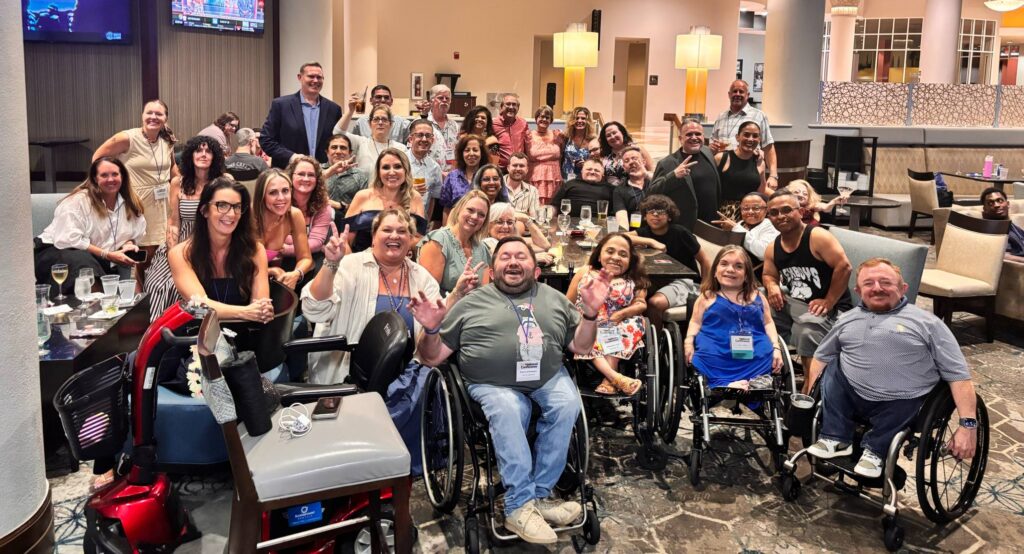
Thank you, Rune, for sharing your Conference experience! This article was published in the Danish OI magazine.
National Conference in Orlando
by Rune Bang Mogensen, Denmark
Some of you may remember that I attended OIF’s National Conference in Omaha, Nebraska, in July 2024. OIF is the Osteogenesis Imperfecta Foundation, the U.S. OI organization. Even back in Omaha, when my travel companion Daniel and I said goodbye with hopes of seeing each other again, I was already dreaming of attending the next National Conference in Orlando, Florida, in July 2026.
So, I was absolutely thrilled when, in the spring of 2025, everything finally fell into place: I was able to get the time off from work, Daniel agreed to be my travel companion again, and, perhaps most importantly, we managed to make the finances work. Daniel and I actually met when we attended a Danish folk high school together in the fall of 2006.
Twenty-six hours after I closed the front door of my home in Aarhus, Denmark, behind me, we finally arrived at the Rosen Centre Hotel in Orlando at around 2 a.m. Thursday morning. The journey had included a flight from Copenhagen to Orlando with a layover in Boston, where we had about four hours to wait, followed by a very warm taxi ride to the hotel.
The conference officially didn’t begin until Friday afternoon, so we had about a day and a half to settle in, explore the hotel, and reconnect with American members of the OI community and their families as they arrived throughout Thursday and Friday morning.
Because of the extreme heat — 35–38°C, or roughly 95–100°F — we decided not to venture too far from the hotel and its blessed air conditioning. Orlando is, of course, home to countless attractions, including Disney World and Universal Studios, so it certainly wasn’t because the city lacked things to do!
As I mentioned, both Daniel and I had been looking forward to this trip to the U.S. for many months. We were incredibly excited to see our American friends again and hoped they would remember us from our time together in Omaha.
That made our reunion with our “new extended family” even more overwhelming and moving. It was wonderful to see them again — and just as wonderful to realize that they had been looking forward to our return at least as much as we had been looking forward to seeing them.
More alike than different
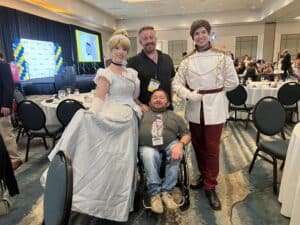 There are quite a few similarities between the way OIF and DFOI organize our conferences — or “annual courses,” as we call them in Denmark. I’m thinking primarily of the overall structure: a combination of presentations, lectures, and member-led workshops.
But there are also some significant differences.
The first obvious one is the size. Around 600 people attended the conference in Orlando (we’re roughly 50-80 in Denmark).
Two other major differences were the sheer number of presentations and, perhaps even more noticeably, the way Americans celebrate and recognize one another.
When it comes to celebrating people and their achievements, I think Americans are miles ahead of us Danes, who are rather fond of our version of the Law of Jante — the cultural tendency to avoid standing out or making too much of ourselves.
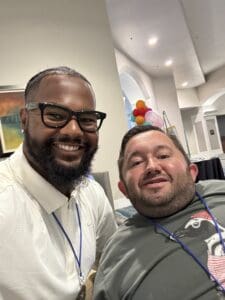
At the conference, there was a real emphasis on celebrating everyday stories and highlighting the many different ways OI affects individuals and families across the country.
One example was Chris Odom, who played professional American football and retired from the NFL in 2025. During the conference’s opening session on Saturday morning, Chris shared his story of becoming a father in 2021 when his daughter, Cassidy, was born with OI.
After Cassidy was born, Chris did everything he could to raise awareness of OI. He talked about it with his teammates and the team’s staff, shared information on social media, and spoke about OI in interviews with several major national television networks.
Another memorable example was the “General Session: OI Through the Years,” which featured three powerful and deeply moving stories from OI families.
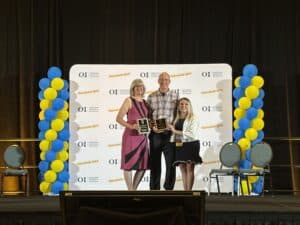
Among them were Sharon and Ted Trahan, the parents of 35-year-old Greg, who has OI. Both Sharon and Ted have served as presidents of OIF, and they received an award recognizing more than 20 years of tireless and inspiring volunteer work for the organization.
I looked around the room and saw several people with tears in their eyes as they listened to these incredibly moving stories and speeches.
Daniel and I were no exception. We were sitting there with tears in our own eyes, and at one point we briefly made eye contact — only to quickly look away again so we wouldn’t completely lose it.
Remembering Francis Glorieux
As many of you know, Francis Glorieux sadly passed away in June 2025.
Francis was a Canadian physician and, in my opinion, about as close as you can get to an OI legend — perhaps even an OI god.
He served as Chair of OIF’s Medical Advisory Council from 2009 to 2023 and remained a member of OIF’s Board of Directors until his death. He was a pioneer in the development of treatments for children with OI and other rare bone diseases.
Beyond his many contributions to scientific research, Francis mentored and inspired countless clinicians and researchers who now dedicate their careers to caring for children with bone diseases around the world.
His legacy continues through the global community he helped build.
To honor him, OIF established the Francis Glorieux Distinguished Service Award. This year’s award was presented to Dr. Cathleen Raggio, a physician and orthopedic surgeon who has distinguished herself through her work on behalf of the OI community and her close collaboration with OIF.
An incredible amount of knowledge
Because everything is bigger in America, there are naturally also many more doctors, healthcare professionals, researchers, and members available to give presentations and workshops.
OIF was therefore able to put together an incredibly full and academically fascinating program.
On Friday, the program ran from 3:30 to 7 p.m. On Saturday, it ran from 9 a.m. to 5:30 p.m., followed by an additional workshop from 9 to 10:30 p.m. And on Sunday, sessions ran from 9:45 a.m. until 4:15 p.m.
Throughout all three days, there were two to four presentations or workshops happening simultaneously, covering an enormous range of topics.
 Some of the sessions included:
- Adult OI Health Panel
- Mental Health and OI
- Cardiopulmonary Health in Children and Adults
- Women’s Wellness and OI
- Aging with OI
- Men’s Health
- Surgical Decision-Making Across the Lifespan
- Adaptive Solutions for Your Home
- Navigating School Accommodations
The quality of the presentations was consistently outstanding, and the level of expertise was incredibly high.
At times, I honestly felt overwhelmed by the sheer amount of new information. More than once, I had to take a short coffee break just to keep my brain from completely shutting down!
If I had been able to — and if my brain had been capable of absorbing it all — I would have loved to attend every single session. Choosing between them was difficult, but unfortunately, I could only be in one place at a time.
A proud Dane
My Danish heart skipped a few extra beats during the opening session on Saturday morning.
One of the presentations was about “Cardiovascular Disease in Adults with Osteogenesis Imperfecta” and included references to several American and international physicians.
When I saw the names of Lars Folkestad and Jannie Dahl Hald on one of the slides, I practically cheered inside. For a moment, I wanted to run around the room waving the Danish flag!
Maybe I’m just a little biased…
Curiosity about life with OI in Denmark
One thing that really made an impression on me was the genuine curiosity everyone I spoke with had about what life with OI is like in Denmark.
People asked about everything: healthcare, hospitals, surgeries, education, employment, everyday tasks such as grocery shopping and household chores, specially adapted vehicles, assistive devices, and much more.
Through these conversations, I realized that even though Denmark and the United States have very different systems and ways of organizing society, there are actually more similarities than differences in how we deal with life and the challenges that come with OI.
It doesn’t matter whether you live in Denmark or the United States — many of the questions, frustrations, hopes, and practical challenges are remarkably similar.
Several American members also told me that they would love to visit Denmark someday.
“Denmark sounds like a fairytale country.”
On that point, it’s hard to disagree with our American friends.
Strengthening the connection
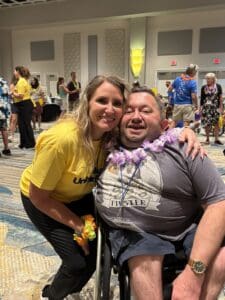 I also had several very meaningful and inspiring conversations with Tracy Hart, who leads OIF’s team of eight full-time staff members; Christine Rossi, the outgoing president of OIF; and Michelle Bunker Fynan, the incoming president.
During all of these conversations, one thing became very clear: there is a warm and longstanding connection with Denmark, along with a tremendous amount of interest in the work being done by the Danish OI organization, DFOI, and the European OI organization, OIFE.
Tracy, Christine, Michelle, and I all agreed that we should prioritize and further develop the collaboration between OIF, DFOI, and OIFE.
I will certainly do everything I can to help make that happen.
My new extended family
Now that I’ve been back home in Denmark for about a month, I can honestly say that attending the conference in Orlando felt like experiencing something truly magical.
I came home with an enormous sense of gratitude, humility, pride, and happiness after meeting so many energetic and deeply dedicated American doctors and healthcare professionals — and, of course, all of the amazing American members of the OI community and their families.
It is a truly remarkable group of people, with so many passionate individuals who are willing to roll up their sleeves and make a difference.
I genuinely feel that I met “my new extended family,” as several of the Americans described themselves to me.
There is something incredibly life-affirming about traveling thousands of miles and discovering people who are so passionate, warm-hearted, welcoming — and, frankly, damn funny!
People who care so deeply about the OI community and who, in so many ways, remind me of the people in our own Danish organization.
As I mentioned earlier, the systems and societies in the United States and Denmark are very different. But when it comes to people with OI and their families, I believe there are far more similarities than differences between Americans and Danes.
I’m convinced that we can learn a great deal from each other if we simply continue to nurture the relationship.
Several of my American friends are already hoping, just as I am, that I’ll make it back to the conference in July 2028.
There is absolutely no doubt that I would love to go. Whether it will be possible, I simply don’t know yet.
But one thing is certain:
I’ve already started dreaming…
Boston
After the conference, Daniel and I headed back to Boston, where we spent Monday evening through Saturday exploring the city.
Boston itself has “only” around 630,000 residents, but the metropolitan area is home to approximately 4.9 million people.
Boston is a fascinating city with an incredible amount to see and do. It is particularly known for its history dating back to the American Revolutionary War, its many universities, and its proud sports tradition, including the Boston Celtics (basketball), Boston Red Sox (baseball), Boston Bruins (ice hockey), and New England Patriots (American football).
When it comes to wheelchair accessibility, I found Boston a little more challenging than Chicago, which we visited after the Omaha conference two years ago.
Boston is also considerably older than Chicago, which, in my opinion, gives it an incredible amount of charm. At the same time, Boston can feel somewhat more chaotic than Chicago, which is a younger and more orderly — or “straightforward,” as we might say in Danish — city.
Overall, though, I find accessibility in the United States to be considerably better than in Denmark, particularly when it comes to public transportation and taxis, tourist attractions and sights, restaurants, sidewalks, and roads.
I can definitely recommend visiting both Chicago and Boston.
So if any of you are planning a trip across the Atlantic, please let me know. I’d be more than happy to share advice, recommendations, and tips!